12 Questions for anyone
who loves and creates art in any form
I
They tell me I’ve become
the person I’ve always wanted to become.
I ask – who was I
and who did I want to become?
“Who wants to participate?” the teacher asked, in a high-pitched voice right after he entered the classroom. He was the House In-charge looking for students to represent his house for some competition that the school would be holding soon – art, speech, basketball. The list continued. Many hands would go up in the air, but only two or three would be chosen. Soon, other teachers who were House In-charge of other houses would visit the class looking for more interested participants. The chosen participants would get to participate, but also often get to skip class without getting reprimanded. That was the coolest bit of it all.
I often watched this scene unfold many times in middle school but never raised my hand. When I moved from a small school to a bigger one, I became shier and quieter. I was a major laggard in extra-curricular activities. I had little clue of what I could do apart from memorising passages from books and finishing all my homework before I got home so that I could play Mario or stare at the TV with some anime show playing on it. I wasn’t good at art, mediocre in music, nightmare in sports, and let’s just forget about public speaking. So one day when our House In-charge entered the class and blared out – anyone wants to participate in a story writing competition? I was still quiet. I was expecting many hands to go up, but surprisingly none did. I knew I wanted to write – that was maybe one thing that I thought I could at least give a shot at. With fear, I raised my hand, which was the only one up in the air at that time. The story writing competition never happened, but I began telling my classmates a story – I would one day become a writer. I had little clue what it meant then.
Today, when I bump into some of my classmates at wedding receptions or networking events, after the how are you, how do you, what do you do formalities, they often tell me I’ve become what that teenager me blabbered to them – that I’ve become a writer. I’ve always wondered back, have I?
In my middle school class, we barely had any kids who wanted to be a writer. No one harboured fantasies of building castles and characters through their writings. Ironically, I was lucky to meet some writer and poet friends in business school. We would sometimes go and watch Word Warriors’ slam poetry events, sometimes even perform. But artistic endeavour was not the biggest chunk of our lives then – it was our undergraduate education in business and some silly stuff that 19 years old would do. And then soon afterwards the reality of just living would hit us. We entered adulthood with bills slapping our faces and with the looming question of how to plan our lives ahead. In a world where stability of all kinds – political, economical, social – eludes us, like sand held tightly, creating art becomes a pursuit that keeps requiring reconsideration. The reconsidering never stops.
I am of course grateful to all the friends I found in school and business school, the ones I danced around in our empty class corridors with, the ones I travelled to places with, the ones who have the patience to help me understand how and why NEPSE works, the ones who hire me to write things for their companies. I am grateful for all these and more. But I have also longed for friends who can understand the writer meme that’s floating on the internet, the ones who can understand what having a Submittable account full of rejection feels like, the ones I can call up for tea to rant about the writer’s block which is sometimes just plain procrastination.
In her novel The Woman Who Climbed Trees, Smriti Ravindra writes, “When my son was born, I immediately wanted a sibling for him, not because I was afraid he would otherwise grow up lonely and sad, but because I knew only a sibling would understand his grief when I or my husband died.” Perhaps every artist has that aching, to find an art sibling or a writer sibling who can understand the joys and pains of artistic pursuit without having to explain word for word. I’m lucky to have found some of them along the way. But the search has to be active, even more so now as I get older and building friendships is not so serendipitous anymore. Perhaps this is why I decided to send an application for Exchange 2023.
Friends and groups we spend time with are an important part of socialising and understanding our world and ourselves. We hang around, we might do some stupid things, but we ask questions, and then we discover and learn. There have always been questions I have wanted to ask my writer and artist friends about their work, their process, their insecurities. I wanted to find a world where I belonged, which was created through conversations.
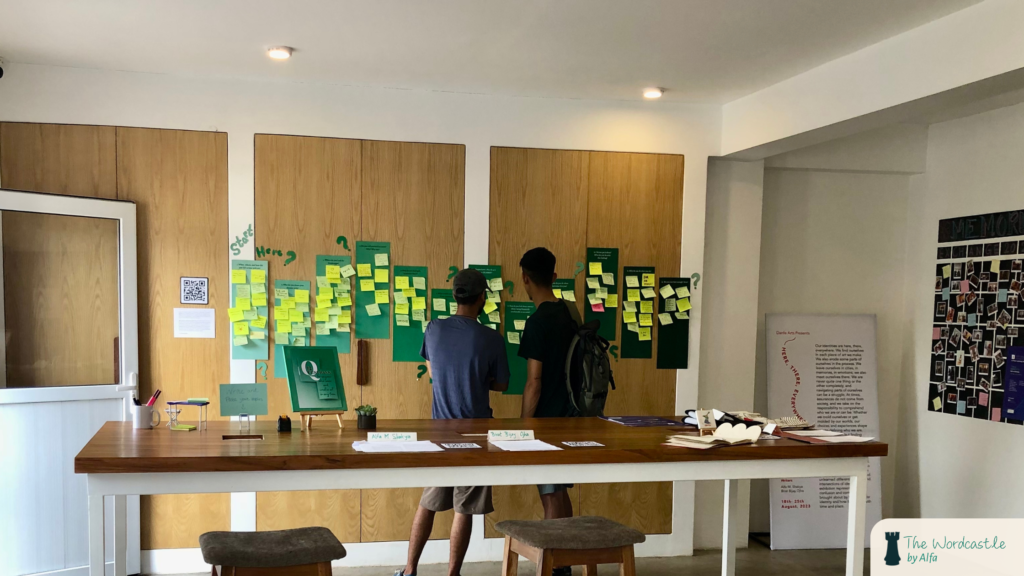
For all these reasons, when The Pomelo team introduced me to Bhanu Kapil’s 12 Questions from The Vertical Interrogation of Strangers, I created my own version dedicated to artists who created art in any form. A part of us makes sense of ourselves and our world through others, and I wanted to find questions and their replies to uncover what it meant to be a writer – to find myself and the identity that I had begun defining as a teenager writing copy-paste stories of cartoons I watched.
12 Questions for anyone
who loves and creates art in any form
- When, where, and how did you fall in love with art?
- Who do you share your dreams with?
- Where do you look for inspiration?
- Do you call yourself an artist? Why? Why not?
- How do you deal with a creative block?
- What would you be doing if not creating art?
- Do you have a Plan B or C or D or JKLMNOP?
- How do you feel about money? About being financially comfortable as an artist?
- What do you do when frustration hits you?
- Do you get jealous? What do you do with that feeling?
- Why do you do what you do?
- Do you ever feel enough? How?
II
If there is thunder and lightning,
fuzzy warm feelings,
violins and songs playing
when we fall in love with a person,
what is there
when we fall in love
with art,
with words –
the things often use
to describe love itself?
The residency gave me time to spend around artists and art processes. Hanging around for tea, helping each other out with our projects, and peeking through our art journals, in between all of these our identities and ideologies rubbed off on each other. The older we become the less we find these spontaneous opportunities to connect. (Note to younger self: do not take college or any group activity for granted).
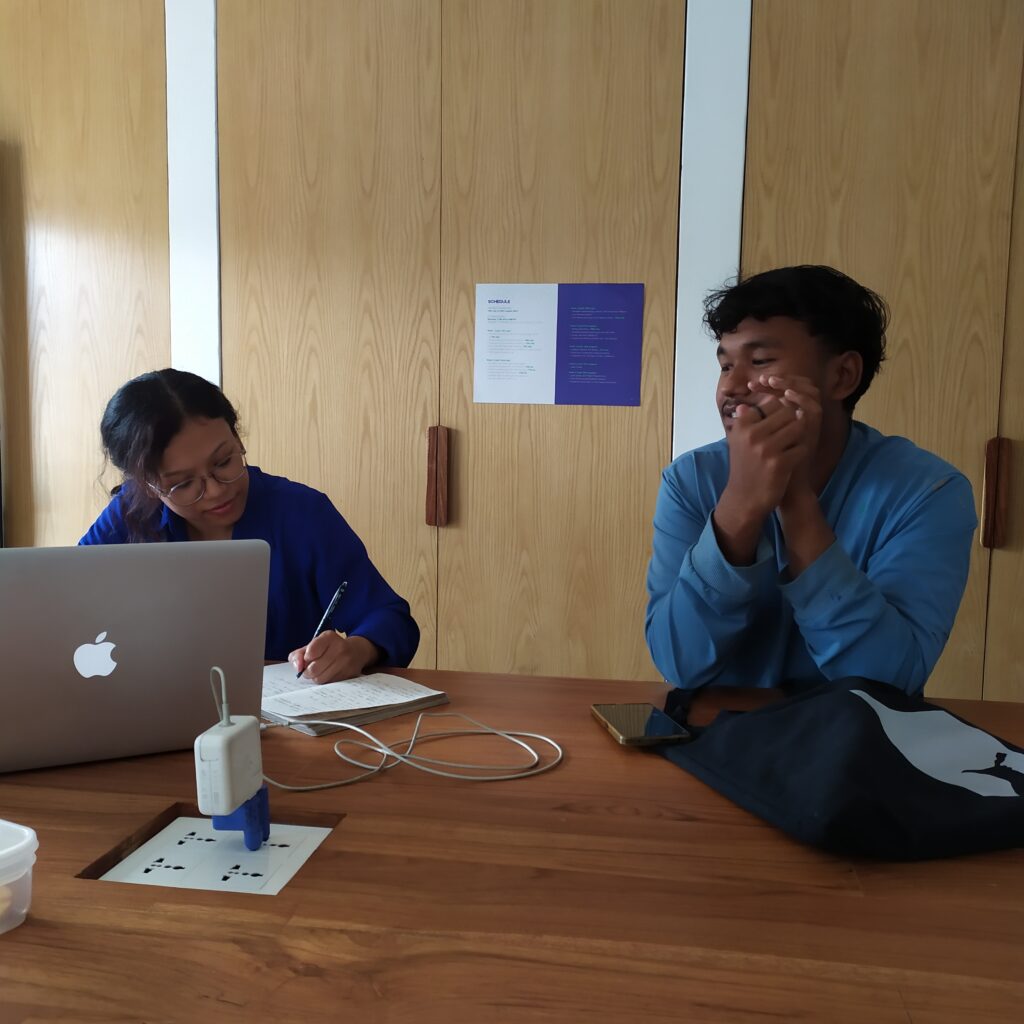
I asked each resident 12 questions circling around their creative endeavours and living as an artist/writer. Not all of the questions and their replies have made it into this essay and I have deliberately picked moments that struck me as a fellow artist – moments that connected and resonated.
My first question, the ubiquitous – how did you fall in love with art? It is a predictable way to begin, but it is the beginning. Before time, there was the big bang, and before the artist, there was the ember that grew to be fire.
Shreemila vividly remembers the moment when she realised art was made for her. Her father, also an artist himself, would often make her sit with her art tools and practice still drawings. Even when she’d move, she would leave all her things in exactly the same places as they were. “I could not even move the chakati as it would change the angle,” she recalls. As a kid, Shreemila did not like the rigour of practising art, but by the time the final image of her painting revealed itself to her, she had already fallen in love with art.
Just like Shreemila, Avishek too fell in love with art through another person’s actions. It was the kind and encouraging words of a teacher to him when he had participated in an art contest in school. “The teacher praised the artistic perspective I had used – how objects at the back are smaller than the ones in front,” he shares. His favourite subject of drawing is human anatomy. His sketchbooks are filled with beautiful, robust anatomy drawings that remind me of the Renaissance era of art.
In his essay titled “Full-Time Writer,” Buddhisagar writes of a common everyday reality of choosing to be an artist. A line from the essay reads, “When I belonged to a workplace and people inquired about my work, I instantly answered that I was a journalist. But after I had taken up writing as a full-time job, I used to stare blankly in the face of this question and, trying not to sound jobless, I told them that I was a writer. People used to dismiss my answer and question me further about my real Work (with a capital “W”).” I wondered if my fellow residents too had felt similarly. I wondered if they had a Plan B or C and if they might walk that path someday.
“Chaina, I don’t have one,” Sailesh tells me of his non-existent Plan B. After a pause, he acknowledges the hurdle that finance often poses for artists. He shares he is glad to be able to pursue and discover art. He mentions that if it weren’t for the art program that started in Jhapa, he would not have pursued art because there would be no school to explore and hone his interest. “I might have been studying science,” he adds. Sailesh comes from the Rajbanshi community and his community’s art and culture inspires him to find out more about his identity.
Avishek and Sailesh, both come from Jhapa and are a part of Tseten Sherpa’s Dehi Art Gallery. They strongly believe that the gallery has helped many youths discover art, and has made it sustainable to follow their dreams of art and to keep plan Bs to the side, at least for now.
Birat, a fellow writer resident, shares that even if he ever has to venture to plan Bs, he would never give up writing. There are indeed some real systemic and structural hurdles to surviving as a writer professionally owing to poor company cultures, less value, and a lack of environment where creativity is appreciated. Despite these, Birat believes that writing will always be a part of his everyday process of understanding the world, expressing and finding himself. He began writing as a coping mechanism to deal with teenage angst and continued writing professionally. “Lekhena vane garo po huncha (It will be difficult for me if I don’t write),” he shares over a Zoom call.
Between the conversations with the residents, between the giggles and the pauses of shared experiences, I am often wondering if I can ask a risky question – a question that could raise eyebrows but also open up doors to a more authentic experience of being an artist. Thankfully, I am able to find ways to bring it up. And one such question centres around the emotion of ‘jealousy’.
Is the moon
jealous of the sun –
of her capacity to never
run out of light,
to keep shining, day by day
every day?
Or is the moon
simply content in her own
waxing and waning of life?
“How do you feel about your peers and contemporaries who are doing better?” I ask, and the first response is often a smile – an acknowledgement of a very human experience. “I get jealous,” most of them tell me in full honesty, owning their feelings. I take a sigh of relief. I couldn’t have been the only one who feels a tinge of envy silently climbing through my back when I see a beautiful piece of writing or someone else who is doing better.
My fellow residents gracefully acknowledge that everyone is different and share how they remind themselves that they do not know the full story of someone else’s work or achievements. It is rather easy today than it probably has been in the history of humankind to compare ourselves with others. If comparison is the thief of all joy, this thief today has a very easy way out, often silently lurking in our pockets. But the answers do not stop there and I receive some kind advice on how to deal with this creeping feeling when it comes.
“I try to work and focus.”
“I will be happy for others and try to be my best version.”
“We are all learning together.”
“It is good to root for others.”
Navigating our conversation through jealousy opens doors to talk about other difficult emotions. My last two questions are heavy, conjuring fervent sentiments, the answers to which we may never find. Yet trying to give words to an experience is what a writer does, and I continue to ask.
Why do you do what you do? Do you ever feel enough? These questions spring from my own observations. I ask them to myself day in and out, and the answers aren’t often kind. I have hardly ever met an artist who is not self-critical. It is almost as though being self-critical and doubtful is a requisite of being an artist, of creating things. Each resident has their own version of why they are doing what they are doing and how they try to feel enough in a world that is constantly making artists second guess and struggle with feelings of not being good enough.
Rose, a fashion designer and visual artist, tells me, “My own work is enough.” She adds that the ‘labour of love’ she has put into her work helps her feel enough as an artist. While technology has made comparisons and insecurities more rife, Rose has carefully curated her Instagram account following artists and accounts she admires. Every time she opens the App, a burst of inspiration awaits her.
During these conversations, I learnt that the word ‘enough’ is a tricky one. While for many feeling enough is important, Naima takes on a different route. She shares that feeling enough is not something that works for her. Naima, who loves working with clay and photography, follows her way in art through curiosity. She tells me she does what she does because she wants to see where it could go.
Elsewhere for Junu, the process is the key. For the residency, she is working on the craft of paper-making and shares humbly, “The final product I am making does not look fancy, but takes a lot of work. The process is what is satisfying.” I recall during the initial days of the residency when someone asked her how her work was going, she would sigh and reply, “I’m still collecting materials.” Junu’s experience echoes Henry Miller’s famous saying, “Writing is its own reward,” or in other terms, creating art is its own reward. And whether finding reasons for what we do is enough or not, we still have each of our arts to hold unto.
III
Buddhisagar’s essay ends on a romantic note. He writes, “Can you really live off of writing? I used to smile at that question. Now, after some time, I have an answer. I don’t know whether you can live off of writing or not. But one thing is certain: if I don’t write, I won’t survive.” My fellow residents do not veer too far away from Buddisagar’s thoughts. They tell me there is nothing else they can imagine doing, that art gives them a kind of satisfaction that makes them forget the world or at times understand it better. Some have followed breadcrumbs that led them to art, and others have found opportunities intertwined with timing.
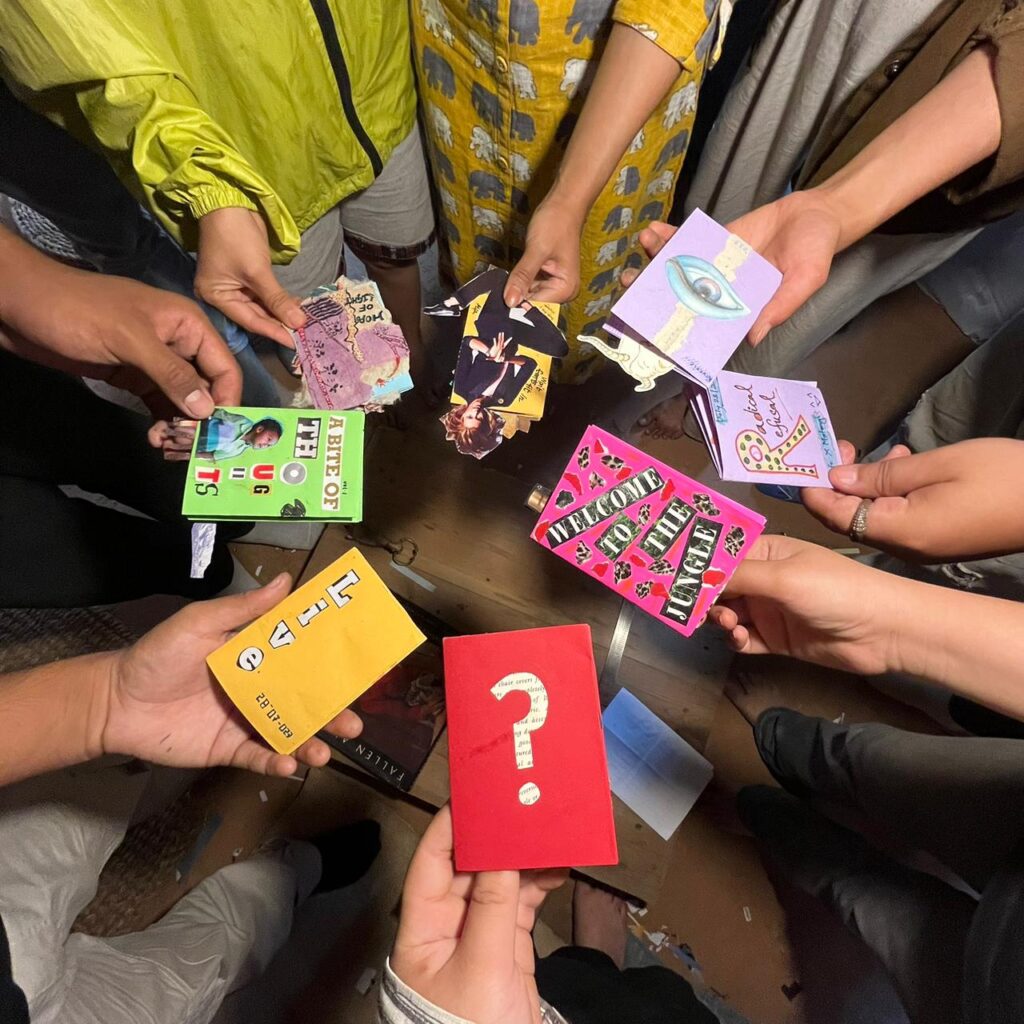
Of course, my questions were not always limited to 12. After 6 weeks of the residency, I know my fellow residents beyond the 12 questions I asked. I know them through the food we have shared, through our common likes and dislikes, through the jokes and laughs that made our stomach ache and caused tears to roll from our eyes. Maybe, I knew generic answers to the 12 questions before I went out asking, but now I know the specific ones – the stories that have a name and a voice that belongs to someone. And in that process, I felt seen and heard.
12 questions can in no way be enough to know someone and their motivations for living and working. It can however be an icebreaker, a gateway to deeper reflections and understanding.
Perhaps the next time I meet some of my school friends at wedding receptions and networking events, I might finally be able to say – yes, I’ve become a writer. And I might never know what that means in full certainty, but as Neil Gaiman would say, “Sometimes writing is like driving through fog. You can’t really see where you’re going. You have just enough of the road in front of you to know that you’re probably still on the road, and if you drive slowly and keep your headlamps lowered you’ll still get where you were going.”
Perhaps it is also time to knock on the doors of my friends, both old and new, who wrote and write mesmerising poetry and stories, and in an Adelesque way say, “Hello, it’s me.”
Maybe they’ve wanted to ask the same questions I’ve been asking. And I might finally have the words to spell them out loud.