
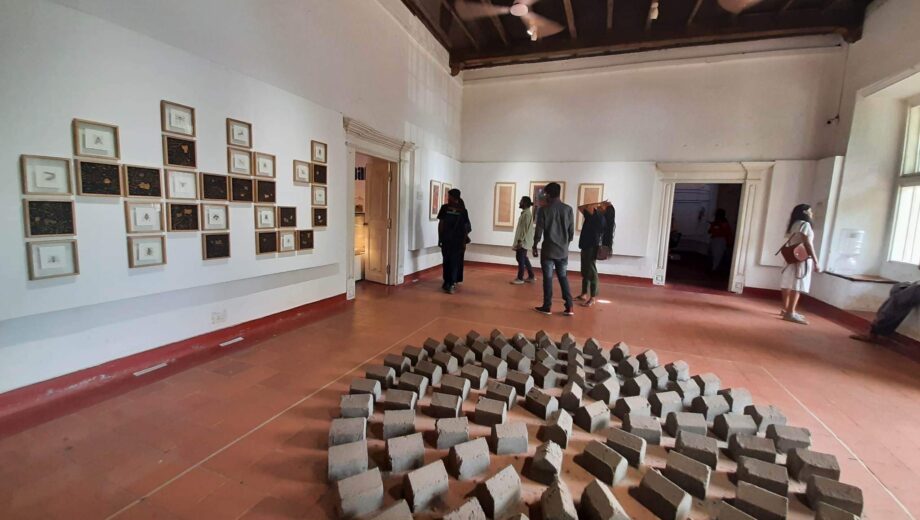
Siddhartha Arts Foundation’s exhibition ‘Memories Of Home’ at the Kochi-Muziris Biennale 2023 explores ideas of home, space, and time with different styles and mediums.
The David Hall at Fort Kochi, in Kerala, is a 328-year-old, striking white building with a low and towering tiled roof. The historical building was built by the Dutch. Surprisingly, however, the building bears the name of a more recent owner, a Jewish man named David Kroder. Currently, the hall works as an occasional gallery space and also as a bookshop, souvenir shop, and a wildly popular cafe.
The December of 2022 saw the gallery space at David Hall in transition—projectors, measuring tapes, cans of paint, masking tapes, and bubble wraps were scattered about—an exhibition was in the making. The exhibition, titled ‘Memories Of Home’ curated for the prestigious Kochi-Muziris Biennale 2022 (KMB), had travelled from the cold weather of Kathmandu, Nepal, to the warm and humid air of Fort Kochi.
In November of 2022, Siddhartha Arts Foundation (SAF) and Kathmandu Triennale were invited to showcase an exhibition for the newest iteration of the biennale under the theme ‘In Our Veins Flow Ink And Fire’. Sangeeta Thapa, Director of Siddhartha Arts Foundation, in her statement, expressed gratitude for the invitation. Thapa considers the invitation and the subsequent participation an extension of Nepal-India relations, not just politically but also through the arts.
Mr Sujan Chitrakar, artist and associate dean at the fine arts department of Kathmandu University, was tasked with selecting a relevant concept and bringing together a pool of artists best fit to represent the foundation and, in turn, the art community at the Kochi Biennale. “This year’s theme of KMB is very open-ended. It’s also symbolic. Fire means passion, and ink refers to expression. This leaves a lot of freedom for artists and curators to explore,” he said.
Chitrakar also adds that as ‘Memories of Home’ was an invited exhibition, it gave him more liberty to delve into a closely related but not fully confined thematics of home, space and migration. For Chitrakar, the idea of home is a timeless one.
Chitrakar, thus, selected a dynamic group of young as well as well-established artists across different mediums, each of whose works fit uniquely into the idea of home. The final lineup consisted of an eclectic mix of artists deeply devoted to their craft: Ashmina Ranjit, Tashi Lama, Bidhyaman Tamang, Jagdish Moktan, Kripa Tuladhar, Pratima Thakali, Pooja Gurung, and Bibhusan Basnet.
*
As soon as one enters through the big wooden door at David Hall, Pratima Thakali’s ‘Parallel Intimacy’ demands undivided attention. It is a large installation featuring multiple house-like structures orbiting one another. Thakali laboriously crafted these structures with sand brought in from the beaches of Fort Kochi within a span of two days. The structures took shape using a DIY plywood mould in which she mixed sand with an adhesive for proper shaping.
Thakali then took these moulds and carefully placed them on the square terracotta tiles on the floor. These moulds weren’t perfect—some were a little disfigured, and in others, cracks developed, risking collapse. But Thakali left them as they were. Rather, the imperfections in the structures are what gave them authenticity. They hint, quite bravely, at the impermanence and fragility of the human condition. “I wanted to allude to the idea of home as an imperfect and dysfunctional space. We tend to romanticise home as this perfect place. But it’s not true for all of us,” she said.
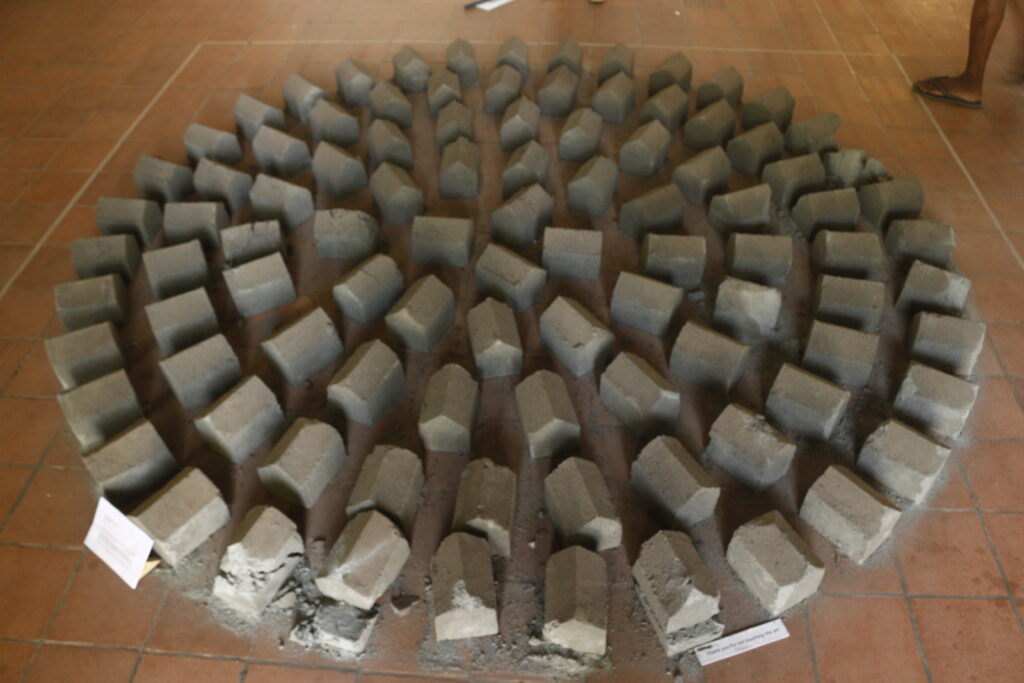
[Image: Parallel Intimacy, Pratima Thakali; Photo Courtesy: Bidhyaman Tamang]
Their gray, cold existence draws the viewer in, compelling them to re-think the very idea of home, which we often associate with warmth and vibrancy, as something that could be cold, cruel, and impermanent. Especially in times of war and conflict, when people are forced to abandon their abodes in favour of safety. However, she added that her probe into looking at the home as a source of distress comes not from hatred or hostility but as a form of acceptance.
Behind Thakali’s work, perched on the wall, is Bidhyaman Tamang’s ‘Memories Of My Soil’. A gallery of small 8X8 inches frames features seeds from different grains and etchings of various insects. Tamang, who grew up in a farming family in Ramechhap, recalled the various insects he played with as a child and drew them from memory. Along with the insects, seeds of popular crops in Nepal—wheat, barley, etc., made up his work. The entire portrayal is surrounded by numbered plots with gold lines drawn on charcoal, representing how farming lands are being turned into plots for real estate.
Tamang’s works are a succinct critique of the loss of farmlands and how insects and seeds are losing lands where they can grow and thrive as urbanization takes hold, concretising not just cities but the villages in Nepal. “The commercially plotted lines and their boundaries are more precious than gold. As the land prices skyrocket, farmers lose their land to concrete structures,” said Tamang.
Tamang reflects on how, as the scapes familiar to them change, he and many others have lost their memories of home, especially from their childhood. The fields he ran around with his friends, where they scavenged for insects, have turned into cold, isolated boxes ready to be traded and exploited for monetary gain.
Right next to ‘My Memories Of The Soil’ is Tashi Lama’s natural pigment paintings—a diptych and a triptych—‘Woven Dreams’, in which Lama paid homage to his mother, who left the comfort of her home in Makwanpur and migrated to Kathmandu in hopes of a better future for her family. It was her tireless perseverance in weaving carpets that put him through school.
Lama honoured the work done by his mother and, by extension, the people working in the carpet-weaving industry. Lama derived inspiration from traditional Thangka paintings—his family’s legacy, to create this unique contemporary work. The diptych carried a texture like that of a carpet itself, and in the centre, the yarns were made of gold. The vibrant orange backdrop allows the patterns of red, blue, and green to dance gracefully, creating a visually stunning piece of work.
The triptych followed a similar theme, the centre painting portraying a weaver as a ‘Bodhisattva’, devoted to her practice, rolling yarn meditatively. Around her are symbols commonly found in Thangka paintings. The outer paintings were left incomplete, opening a window into the labour of these paintings—the tiny squares Lama fills in with precise single strokes are a testament to his dedication to his craft.
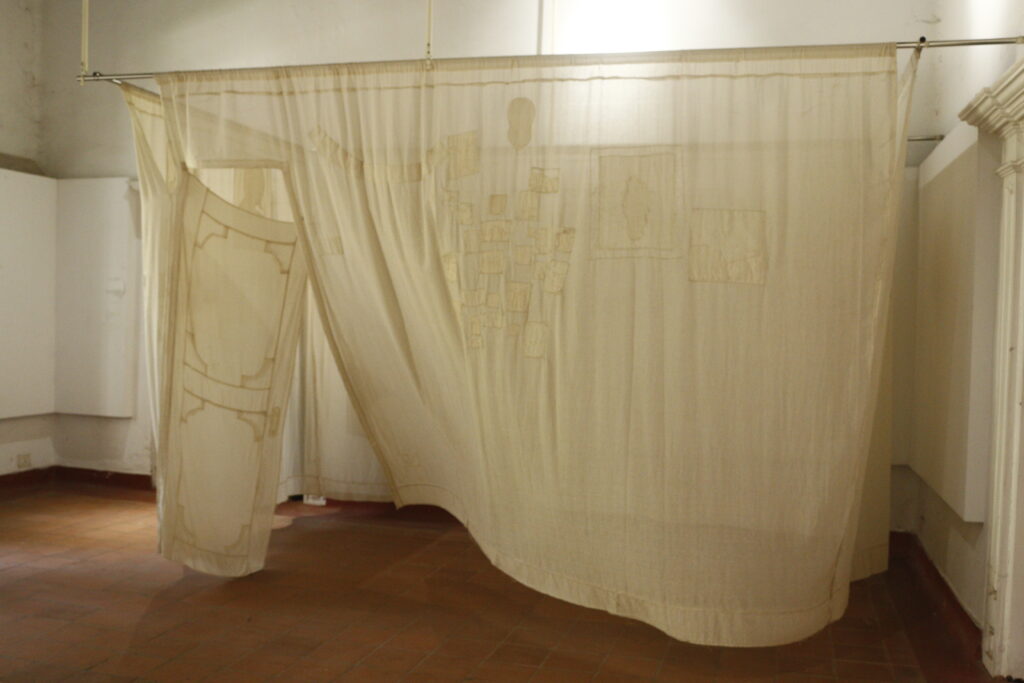
[Image : A space in me = Me in a space, Kripa Tuladhar ; Photo Courtesy: Tashi Lama]
The left of the foyer housed an installation titled ‘A space in me = Me in a space’ by Kripa Tuladhar. It was a large textile replication of Tuladhar’s room—her four walls, a ceiling, a window, a door, and countless memorabilia, posters and pictures were sewn across the large drooping fabric walls. During the COVID-19 lockdown, Tuladhar reveals she learned to embrace her room as not just a place to sleep but a space of comfort and belonging. Tuladhar used a Korean quilting technique called ‘Pojagi’, which involves sewing patches of fabric together to a larger body of work. “I wanted the fabric to be translucent,” said Tuladhar. “Because even though I was confined to these cemented brick walls, my room felt fluid. I felt free.”
This idea of freedom reverberates in Kochi as well. The four walls of translucent off-white fabric dance along with the wind that flows across the foyer. Inside this room, one is confined yet free at the same time. Tuladhar’s installation stood out as a unique, well-crafted artwork, constantly drawing in curious viewers.
The room on the right to the foyer features works by two artists—Ashima Ranjit and Jagdish Moktan. Ashmina Ranjit’s work titled ‘Migration—Space and Dreams’ is a compelling installation that reflects the perils of thousands of migrants that leave Nepal—leave home—to find work. This particular work also resonated with the migration realities of people from Kerela. In her introduction to the exhibition, Sangeeta Thapa writes, “Many migrant labourers from Kerala and Nepal leave their ancestral homes for the metropolis, and many migrate abroad in search of better prospects. This unprecedented exodus of people is fueled by war, pogroms, climate change, natural disasters, and a general lack of economic opportunity. [It is] a shared narrative of the plight of South Asian peoples.”
As one enters the room, one is greeted with a two-dimensional image of a bunk bed. Created by the merging of lines of tape on the wall, the borders are a deep blue and extend over to the floor. On the walls above and in between the beds were images close to home—photographs of a lover, family members, a calendar marking the days to go back to Nepal, and gods and goddesses watching over with their protective glance.
This image is common among migrant workers working tirelessly in Qatar, Malaysia, and Dubai. Their abode is a small bed (perhaps even smaller than in the installation) in a cramped room they share with others like them.
The bed was simply a mirage, it only came to life when looked at through a certain angle; otherwise, it is simply a chaotic meeting of lines. This feels intentional on Ranjit’s part because no matter how long they spend trading their time and labour in foreign countries, it never truly becomes their home. The bed never provides the comfort they feel while sleeping with their loved ones back in Nepal.
So, as they go to sleep, they dream of their actual home, their life back in Nepal. Right above the bed, visuals of festivals, historical events, and family juxtaposed to form the dreams that each migrant worker sees as they go to sleep.
Jagdish Moktan’s ‘Evocation Of Home’ features oil paintings and a video projection. The central focus was the hyperrealistic painting of a woman wearing traditional earnings and ‘bulaki’—modelled by Moktan’s aunt—covered in ‘kamero mato’ (a chemical similar to lime powder used while building traditional houses) looking directly at the viewer with a satisfied smile.
“My family and I were repainting our ancestral home for the festivals. As I looked over, I noticed my fupu covered in kamero,” said Moktan. In the video, Moktan re-created the process of renewing his home—Moktan slathers red mud on the canvas and onto himself, finding a sense of belonging.
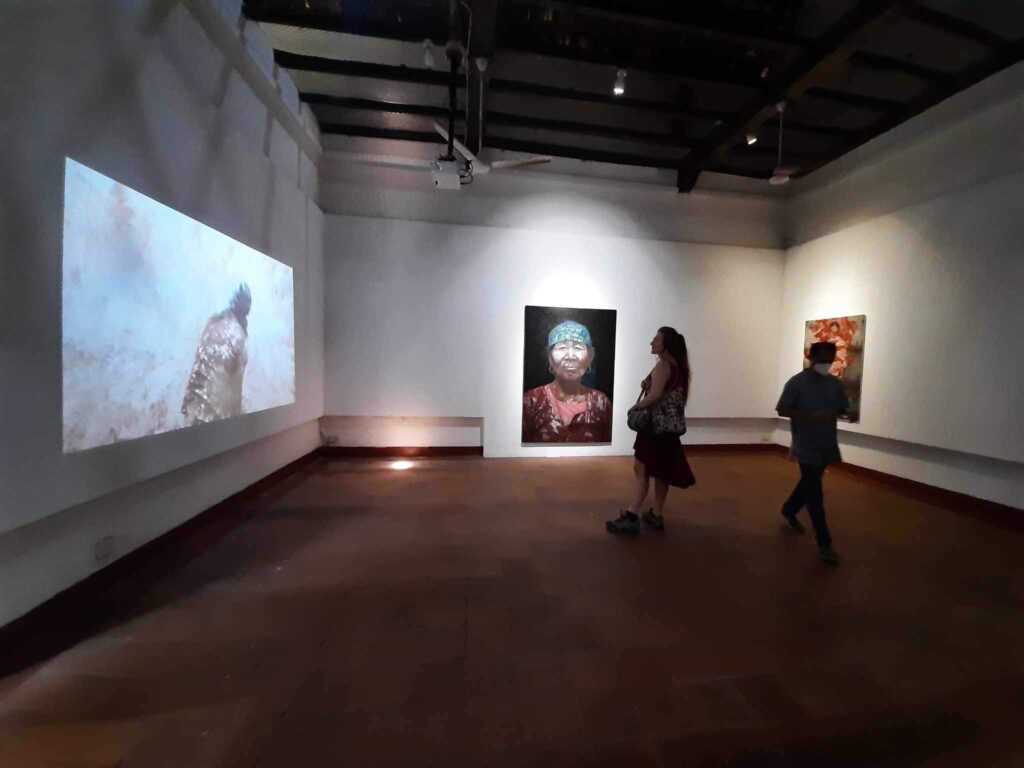
[Artwork Shown: Jagdish Moktan; Image Courtesy: Bidhyaman Tamang]
Another oil painting featured a recreation of an old monochromatic picture of his father when young, juxtaposed with dynamic red lines crawling all over the frame. Moktan’s father, like Lama’s mother, came to Kathmandu in search of a better future, slowly building a life from scratch while providing for his children and family. The red lines took the shape of an abstract dragon, symbolising a brave, unwavering figure that manoeuvred along the chaos of the urbanscape to build a life of comfort for his children.
The room left of the foyer had been transformed into a small movie hall—showing Pooja Gurung and Bibhusan Basnet’s acclaimed film ‘Dadyaa: The Woodpeckers of Rotha’—a masterfully crafted short film that is at once warm and haunting. The 2016 film won two awards at the Sundance Festival in 2017.
Dadyaa was shot in a picturesque village of Jumla—the cinematography was sombre yet beautiful. The blue hues, the white snow, and the gloomy brown and black of the wet, cold trees and branches were a marvel. Dadyaa follows a story of an old couple (played by Devi Damai and Parimal Damai) who try to cope with their sons leaving home. In what is an ancient tradition in their village, the mother carves wooden sculptures—large faces with sunken cheeks and uncanny eyes— and dresses them in her son’s clothes. The idea of these eerie-looking figures was to ensure that some form of presence should always be in the house—as a form of remembrance. The couple eventually created their own wooden figures and left home, only to find their village completely deserted, filled with these haunting wooden figures, with nothing alive in sight.
Dadyaa was a masterpiece. It was captivating and incredibly powerful. The jarring reveal of a deserted village covered with these uncanny and unmoving wooden figures hit the viewers with a realization of how gravely migration has affected lives, especially in villages. It forces us to come to terms with the lonesome experiences of those left behind—mostly the children and the elderly.
*
The installation of the exhibition ‘Memories of Home’ was not without its difficulties. Thakali lamented, “There was a lot of waiting. When the material was available, the manpower was not and vice versa”. The production work was incapacitated by the untimely arrival of materials and manpower. Swift promises for timeliness were made, but they were rarely delivered.
The big shock hit when a last-minute postponement of the opening was announced, with the official opening on the 23rd of December instead of the 12th. In an open letter published by participating artists, they lamented KMB’s “shockingly poor communication” and “an absence of capable people at the appropriate time, despite the curator’s and artists’ constant calls, to find them”, among many other valid complaints.
‘Memories of Home’, like several other exhibitions around Fort Kochi, was at risk of being stuck in limbo. However, the diligent team and the KMB volunteers worked tirelessly, often working late mornings and nights, to put up the exhibition. ‘Memories of Home’ officially opened on the 13th of December, 2022, only a day behind schedule.
All in all, ‘Memories of Home’ was a well-crafted show. It dealt with the joys and perils of the present times— mainly highlighting the constant flux of people in and out of countries, towns, cities and villages and how these movements have affected our personal and collective psyche.
—
Acharya currently works as a culture and lifestyle reporter for The Kathmandu Post. She is also the media coordinator for Siddhartha Art Gallery.