
As I entered the dark but mysteriously illuminated room of Chyasal, a thousand flickering fireflies emerged in front of a screen and I was immediately transported to a magical land in Sriram Murali’s Minmini. It brought to mind the one occasion when I caught a glimpse of a firefly or two while spending the night at Shivapuri, but this was pure enchantment. It made me wonder if there is anywhere in Kathmandu or all of Nepal that has so many fireflies, but I dismissed the idea because I’d never heard of it. But the thought wouldn’t go away, so I asked Diwas Raja KC, the Head of Research & Archives at Nepal Picture Library who then told me that a decade ago, we could notice the presence of fireflies or junkiris as we refer to them in Nepali in Kathmandu valley easily. But where are they now? Have they disappeared from this landscape or have we just stopped noticing them?
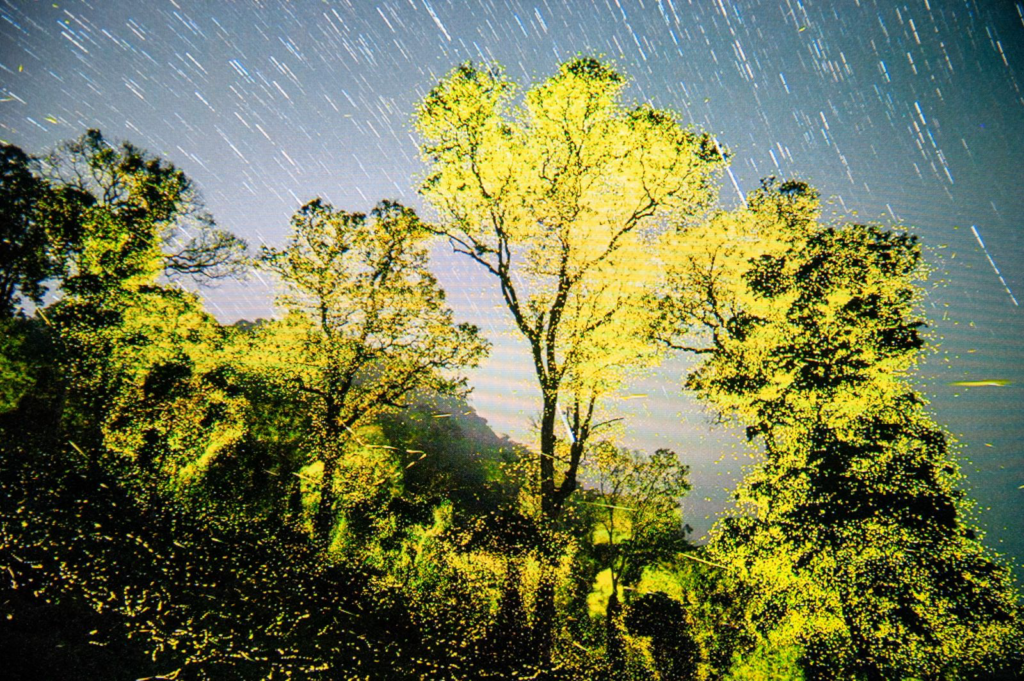
Image: Minmini by Sangya Manandhar
Minmini was a part of the fifth edition of Photo Kathmandu – Nepal’s biggest photo festival that took place between 25th February to 31st of March, 2023 across six different venues in Patan. The festival was a celebration of all that lies around us, all that we’ve lost, all that is present and can still be protected and all that’s hidden beneath our feet. Photo Kathmandu is organized by photo.circle, a platform for photography based in Kathmandu founded in 2007 with the festival director NayanTara Gurung Kakshapati at the helm of it. This edition, the festival’s curatorial team, included Shristi Shrestha, Diwas Raja KC, Prasiit Sthapit, Irina Giri, and Shikhar Bhattarai.
PhotoKTM fosters dialogues between the city, its public, its past, and its aspirations. The festival invites photographers and other practitioners who engage with or through the visual medium to create, present and participate in an exhibition program, workshops and symposia, a residency, an incubator program for practitioners from across South Asia, a local arts education program for young people in the city, and various collaborative pop-up events among other core and collateral programming. Each edition of PhotoKTM builds on ideas of assemblage and collectivization. It platforms several collaborative artistic, research and educational initiatives that make an effort to contribute to on-going local conversations and campaigns.
PhotoKTM5 Theme
Since its inception in 2015, Photo Kathmandu has gained worldwide recognition for its professionalism and creativity, and has raised the bar for other art festivals in Nepal. This year, the festival addressed a deep, alarming issue: our relationship with the natural world.
This edition of PhotoKTM was dedicated to bringing together a community of storytellers, to think about what role we can play in giving non-humans voice and agency while so many of our communities still struggle to do so; to rebuild relationships to land and place despite so much forced relocation and flux; to question how contemporary values that frame knowledge production, meaning making, language and rubric might be failing us; and to learn anew how to pay attention, give name, mourn loss, make place, relearn histories, see beyond; and to move towards a shared politics of mutualism, collaboration, justice and care.
With revelations about how to orient us to the future by fusing language and landscape, PhotoKTM5 delved into the bizarre and alarming ways we’ve changed the world. It acted as a guide, reminding us there’s so much in the world to wonder at. In the fifth edition, the streets of Patan underwent a dazzling transformation inspiring urgent reflections on our relationship with the planet.
Given the thoughtful curation of the festival, once you walked in it and immersed yourself in the artworks, it felt like someone grabbed your hand and said, “Let’s go on a journey and discover something together.” The curators played a significant role in developing a framework for the exhibitions, creating a theme, and finding artists that perfectly fit the thematic narrative of the festival. This year PhotoKTM had six clusters that were developed to act as the primary framework for contextualizing projects and issues being presented. The six clusters were: Paying Attention, Giving Name, Walking our Questions, Making Place, Relearning History, and Learning from Doubt.
The Curatorial Process
When asked about the process of finding artists or artworks and projects that would fit the thematic narrative of the festival, Sthapit, the curator of the Chyasal and Khapinchhen exhibits, emphasized that at PhotoKTM the focus has never been on bringing forth only eminent names but also on showcasing works of upcoming artists of significant importance and relevance who may or may not have ever been heard of.
The festival brought together works of several artists and researchers who might not necessarily wrap a camera around their neck or fit into the regular norm of what a photography artist is. What mattered most was the knowledge that they sought, the issues they were delving into which may either be personal, philosophical, scientific or abstract.
When identifying works that could possibly be showcased at the festival, the curatorial team went back to all the works they had previously seen or heard of in the past as individuals and fit the narrative theme of the festival. Amongst all the works that came together, DB Chaudhary’s work “As We Know Them: Bird Names in Tharu” was a wonderful discovery that they had never heard of before but was the ideal fit under the festival’s cluster ‘Giving Names’. Growing up in Nawalparasi, DB Chaudhary knew the birds and animals he saw every day by name in his native language: Tharu. “Knowing their names in a language that I spoke helped me develop a connection with birds, mammals, plants and other wildlife. I was attached to them and that made me care more for them,” says DB Chaudhary. DB Chaudhary is on a quest to collate and document bird names in local languages spoken in Nawalparasi, including Tharu, Bote, and Musahar, in the hopes that giving names to birds in his local language will inspire others to care more about birds in their surroundings.
Each cluster at the festival had a distinct thematic focus and goals that it sought to achieve. For instance, through the “Relearning History” the festival included exhibits such as the “Skin of Chitwan” and Ariella Aïsha Azoulay’s “The World Like A Jewel In The Hand” that ought to reconsider the way we are taught about our past.
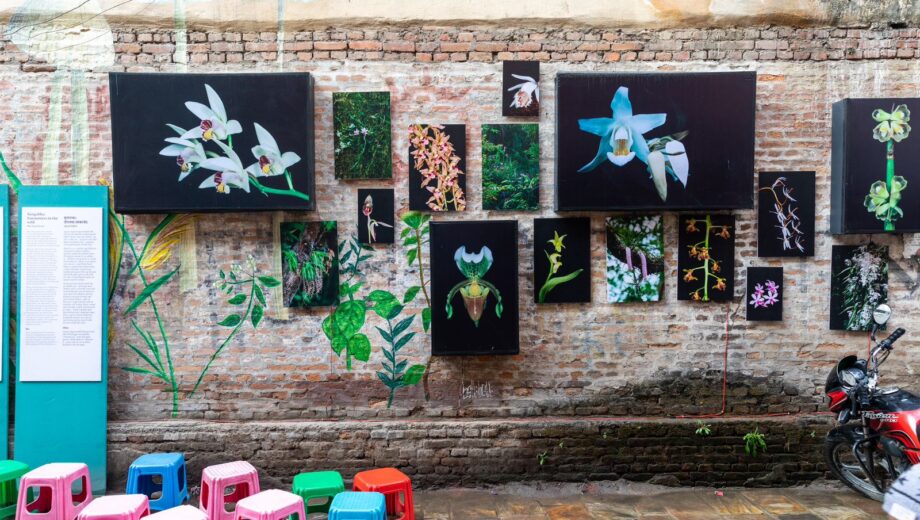
Likewise, under the sub-theme “Paying Attention” the festival included exhibits such as Esha Munshi’s “Feather Library”, life-sized books on birds in “Chhimeki Chara” and Sriram Murali’s Minmini. In an effort to draw in the community and passersby, this particular cluster was displayed on the streets of Patan, encouraging participation from people of all ages. It is crucial to display art in public places like streets and squares because it increases accessibility for nearby residents.
The festival’s many clusters were displayed in various locations all throughout Patan. Bahadur Shah Baithak featured “Relearning History,” while the displays at Khapinchhen focused on the “Giving Names” cluster. A group of artists, including Uriel Orlow, KTK Belt, and DB Chaudhary, had exhibits here.
Despite coming from various parts of the world, the various exhibitions complemented one another. While Chaudhary’s work aims to conserve the names of birds in Tharu and other indigenous languages of Nawalparasi, Orlow’s work “What Plants Were Called Before They Had A Name” also reveals how Latin plant names brought to Guatemala by Spanish conquerors have invaded the knowledge of the land.
The festival displayed the works of Nepali and international artists in communal settings including guthi homes, bhwe chhen, phalchas, and dabalis. Several works that had previously been showcased in different settings internationally were adapted to fit the communal settings and local aesthetics. For instance, Orlow’s work had previously been showcased in an entirely white setting at PAV Parco Arte Vivente, Turin in contrast to an entirely darker one that was created for the exhibition at the bhwe chhen in Khapinchhen.
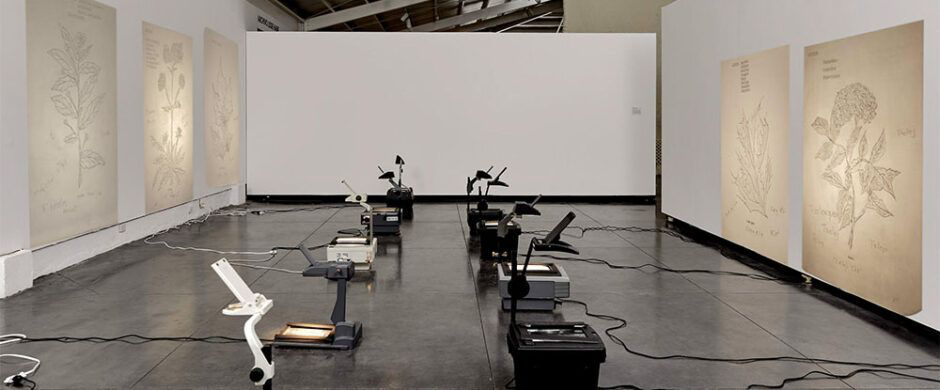
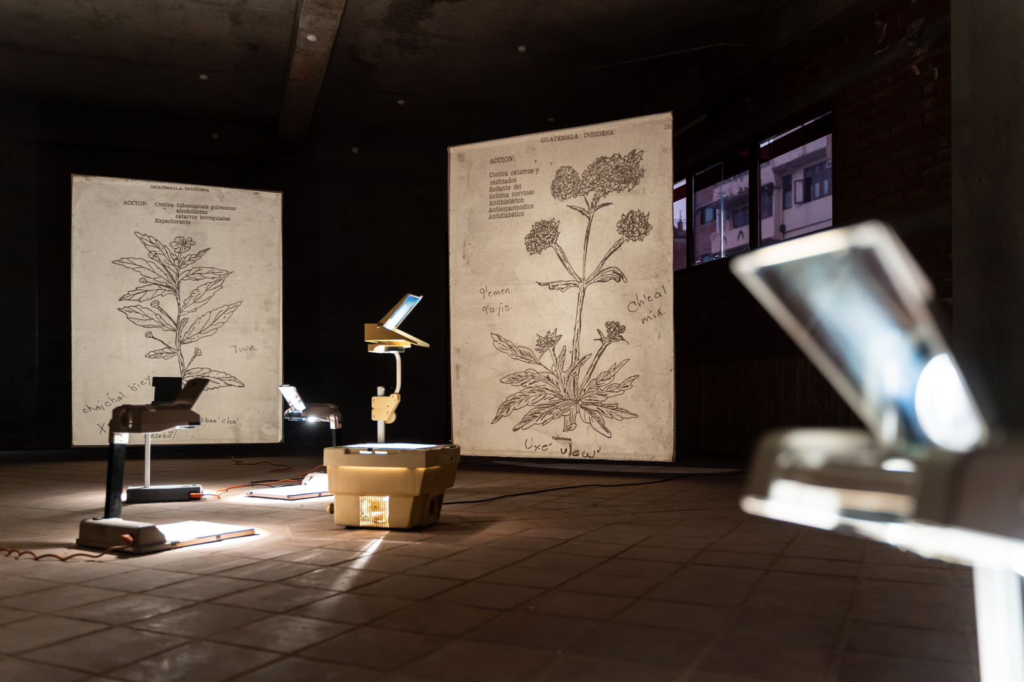
Image 1 : Uriel’s Exhibition at PAV Parco Arte Vivente, Turin
Image 2: Uriel’s Exhibition at Photo Kathmandu, Khapinchhen
In addition to the outdoor exhibits, the festival also largely featured indoor exhibits in galleries and other venues such as Bahadur Shah Baithak, Patan House, Namkha, and Gallery MCube. To dispel the idea that art in galleries is sterile and inaccessible, the curatorial team attempted to make these gallery exhibits more interactive and approachable. While Bahadur Shah Baithak provided visitors with the chance to interact with various installations using microscopes, magnifying glasses, and overhead projectors, Patan House allowed people to scrawl their ideas and experiences on the gallery walls.
Artists such as Ganga Limbu and DB Chaudhary have repeatedly emphasized on the crucial role of the community in their works and PhotoKTM5 aims to inspire a similar sense of community building and bond that can bring people together to share, preserve and conserve indigenous knowledge and their surroundings. To create an experience that a large audience could connect with and enjoy, creating interesting and interactive exhibition spaces via the power of storytelling, community, and resilience were at the center of the festival.
So much art was strategically spaced out yet concentrated into the few square kilometres of the picturesque neighbourhood of Patan that it could sometimes be an overwhelming emotional and intellectual voyage. Finding the appropriate directions from one location to the next was more than simply a logistical concern when navigating the festival’s several venues — it was also about letting the eye and the mind assimilate and make sense of the impressions being made upon them constantly. In all this chaos of beauty, the Chhimeki Charas became an anchor.
Striving to fuse more human finesse and elements of nostalgia through the works showcased at the festival, PhotoKTM5 introduced personal memories with the hope of inspiring new ones for most of us. After engaging closely with the Chhimeki Chara campaign from the festival, I now wake up to the sounds of birds chirping at my window with a growing curiosity to learn which birds are chirping around me everyday.
“If even one visitor from the festival leaves with a provocative thought, consciousness or the curiosity to soak up their environment and pay more attention to the things around them, we have succeeded in our goal. All we seek for is that”, said KC.
In an age of ecological catastrophe, the surface world and the present are full of mixed things, blending the exquisite and the horrible. Any decent way through this time will need to find, in the exquisite and the horrible, reminders of the utter preciousness of ordinary places and things. PhotoKTM5 showed that the world is not disenchanted, and that our minds need not be either. Mystery abounds, and grows with knowledge. It was a festival that makes you want to think more adventurously and live more deeply – beautifully and bravely balanced.
Extensions of the festival
The opening week of the festival also invited several artists such as Karachi-based artist Fazal Rizvi and writer, researcher and curator Aziz Sohail, for a lecture performance, On Drifting and Rooting, to reflect on the importance of coming together to tell our stories. There was also a presentation on The National Geographic Society Grant Seminar by Yannick Kuehl and David Lee. Several artists such as Mónica Alcázar-Duarte, Uriel Orlow, Munem Wasif, Alana Hunt and others who were exhibiting at the festival were also invited for artist talks and panel discussions.
The PhotoKTM5 opening week also included Review Sessions, a platform for emerging photographers, lens based practitioners and visual artists to meet established industry experts to get inputs on their work and have general conversations about building their practices.
Photo Kathmandu collaborated with Srijanalaya, an NGO that uses the arts to create safe spaces for learning, to organize guided tours of the exhibition for public and private schools and colleges in Kathmandu Valley playing a crucial role in engaging and making the festival accessible to a wider audience. Their mix of engaging and free public programs during the festival were open to the public and worked towards their mission to expose, educate, engage and entertain audiences by presenting and supporting the art and artists that were a part of the festival.
The Photo Kathmandu exhibition has evolved into more than just an exhibition for visual art; becoming a platform for fostering ties among communities, initiating conversations and engaging communities. Over several exhibition iterations, they have cultivated connections that go beyond the confines of Patan.
The festival featured interactive artwork installations anchoring the festival; activating and reimagining alleys, and blank walls across Patan in new and inventive ways. The artworks invited play and participation, engaging area locals in an event that outwardly reflects the creative community and culture that thrives here. Navigating the artworks across the busy, bustling streets of Patan felt a bit like stepping into and outside reality at the same time.
What a total delight PhotoKTM5 was! Once again, so many enlivening encounters along paths less frequently trod. PhotoKTM remains our guide, reminding us there’s so much in the world to wonder at. Until we meet again!